

With ParexelAI™, you're not just optimizing your current development timeline, you're unlocking the ability to run more programs simultaneously across our global network and compress critical timelines. In a landscape where speed to market directly impacts patient outcomes, ParexelAI empowers you to innovate and make a meaningful difference in patients' lives.
Faster delivery that's reliable
ParexelAI represents a transformative opportunity for companies seeking to accelerate their path to patients. This innovative, proprietary suite of AI services and capabilities fundamentally reimagines clinical development by combining our operational excellence with cutting-edge AI technology. By partnering with Parexel, you gain access to a fully AI-enabled clinical development partner that delivers greater speed, quality, and efficiency.
How ParexelAI is driving value
%
reduction in site selection process timelines
%
reduction in clinical study report preparation
%
efficiency gains in safety literature review and case processing
Supported by strategic partnerships
- Through its strategic partnership with Paradigm Health, Parexel is transforming patient identification and trial access across a network of 800+ research sites and 2,100+ provider locations.
- Working with Weave Bio, Parexel is reducing Investigational New Drug (IND) and New Drug Application (NDA) authoring timelines by 60% through regulatory automation, helping sponsors reach high-stakes regulatory decisions sooner than previously possible.
- Parexel was the first CRO to adopt Palantir’s Artificial Intelligence Platform, which serves as the backbone for its AI-enabled clinical operations, supporting faster, higher-quality study delivery.
- Parexel also leverages partnerships with other leading technology companies to access the latest innovations and provide its customers with a truly AI-enabled clinical development partner.
Case Study 1 of 4
Transforming clinical research associate productivity with citizen developers
Situation
Challenges
Solution
Result
To improve delivery speed and support the “safe to proceed” path for sponsors, Clinical Research Associate (CRA) teams needed streamlined, automated workflows.
Situation
To improve delivery speed and support the “safe to proceed” path for sponsors, Clinical Research Associate (CRA) teams needed streamlined, automated workflows.
Challenges
Solution
Result
Advantages
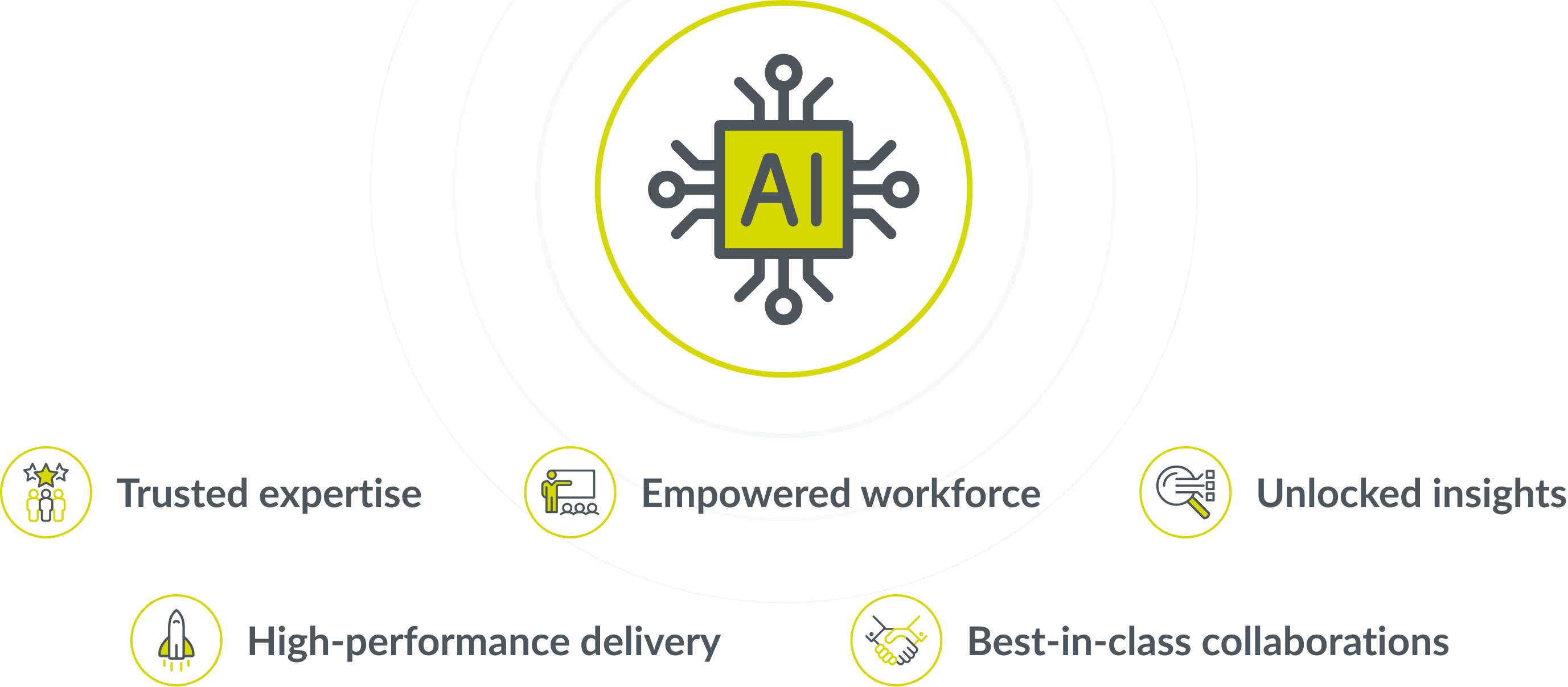
Trusted expertise
Risk managed, compliance assured — human-led AI combines regulatory rigor with intelligent automation to drive operational excellence and protect data integrity.
Empowered workforce
AI solutions elevate experts to focus on problem-solving and higher-impact challenges to
deliver solutions others don’t see.
Unlocked insights
Drive smarter decisions and faster trials — AI surfaces predictive insights at every stage, reducing protocol risk, study delays, and costly trial amendments.
High-performance delivery
Consistent operational excellence, delivered at speed — end-to-end AI eliminates rework and manual bottlenecks to accelerate site activation, enrollment, data analysis and submission timelines.
Best-in-class collaborations
An intentional partner strategy with best of breed providers unites domain expertise with access to leading AI platforms for solutions that drive innovation, reach new patients and deliver speed with precision.
AI drives speed without shortcuts across the clinical trial lifecycle
-
Study design optimizer
Impact: Informs fit-for-purpose protocol design through rapid analysis of similar public protocols -
Protocol abstraction
Impact: Expedites insight identification for protocol design from past Parexel protocols -
Study companion
Impact: Analyzes historical data from past Parexel projects to optimize early feasibility
-
Patient recruitment
Impact: Speeds patient recruitment & time to first patient in (Paradigm Health) -
Patient motivation assessment
Impact: Identifies patients and measures motivation to inform protocol design impact and patient engagement strategies -
Site feasibility
Impact: Rapid data analysis across global site networks enables fast site identification based on protocol requirements -
Contract Automation
Impact: Uses historical data to automate draft generation and reduce site contracting timelines
-
Regulatory compliance
Impact: Enables proactive compliance by automating Clinical Trials Information System (CTIS) monitoring -
Study Data Tabulation Model (SDTM) Generation
Impact: Automates creation of SDTM datasets, disparate data integration and streamlines data workflows -
Safety processing
Impact: Automates safety literature review, enabling earlier signal detection -
Safety Individual Case Safety Report (ICSR) Intake
Impact: Accelerates delivery timelines for individual Clinical Study Reports (CSRs) -
Resource management
Impact: Enables precision resourcing for full-service outsourcing and functional service provider delivery models
-
R Biostatistical Platform
Impact: Automates R workflows to ensure regulatory-ready analytics -
Statistical Analysis System (SAS) Code Reviewer
Impact: Drives faster quality review of SAS coding -
Clinical Study Report (CSR) Generation
Impact: Generates quality control for CSR draft, resulting in 30% CSR timeline reduction
How we're different
Our latest insights
Article
Cyber security 101: Tips to protect your site from a cyber threat
Oct 13, 2026
Article
AI at clinical sites: Practical tips for safe & effective use
Oct 13, 2026
Blog
Regulatory submissions as a source of insight: How AI can amplify the value of our work
Jul 15, 2026
CTB Blog
Modeling & simulation and artificial intelligence for early drug development
Jul 14, 2026
Blog
Human-centered AI - A dual-layer model for clinical research excellence
Jul 1, 2026
Blog
The connected submission - How AI, automation, and intelligence are changing the regulatory ecosystem
Jul 1, 2026
CTB Blog
Modernizing data operations to enable today's Phase 1 trials
Jul 1, 2026
Whitepaper
AI-powered pharmacovigilance: From reactive reporting to predictive risk
Mar 24, 2025
Podcast
Enabling Successful Sites: Episode 4, Part Two: Leveraging AI to improve patient recruitment and retention
Jan 6, 2025
Whitepaper
Harnessing the Benefits of Externally Controlled Clinical Trials (ECTs) to Accelerate Development of Better Medicines
Nov 25, 2024
Article
Human-in-the loop AI: a proven approach to streamlining PV case processing and review
Oct 7, 2024
Blog
Transforming evidence generation: How predictive AI can optimize clinical development
Sep 3, 2024
Blog
The future of drug development: Leveraging EMA support for use of alternative nonclinical approaches
Jun 6, 2024
Blog
Regulatory acceptability of AI: Current perspectives
Mar 7, 2024
Article
Parexel principles for artificial intelligence (AI)
Mar 6, 2024
Our latest insights
Article
Cyber security 101: Tips to protect your site from a cyber threat
Oct 13, 2026
Article
AI at clinical sites: Practical tips for safe & effective use
Oct 13, 2026
Blog
Regulatory submissions as a source of insight: How AI can amplify the value of our work
Jul 15, 2026
CTB Blog
Modeling & simulation and artificial intelligence for early drug development
Jul 14, 2026
Blog
Human-centered AI - A dual-layer model for clinical research excellence
Jul 1, 2026
Blog
The connected submission - How AI, automation, and intelligence are changing the regulatory ecosystem
Jul 1, 2026
CTB Blog
Modernizing data operations to enable today's Phase 1 trials
Jul 1, 2026
Whitepaper
AI-powered pharmacovigilance: From reactive reporting to predictive risk
Mar 24, 2025
Podcast
Enabling Successful Sites: Episode 4, Part Two: Leveraging AI to improve patient recruitment and retention
Jan 6, 2025
Whitepaper
Harnessing the Benefits of Externally Controlled Clinical Trials (ECTs) to Accelerate Development of Better Medicines
Nov 25, 2024
Article
Human-in-the loop AI: a proven approach to streamlining PV case processing and review
Oct 7, 2024
Blog
Transforming evidence generation: How predictive AI can optimize clinical development
Sep 3, 2024
Blog
The future of drug development: Leveraging EMA support for use of alternative nonclinical approaches
Jun 6, 2024
Blog
Regulatory acceptability of AI: Current perspectives
Mar 7, 2024
Article
Parexel principles for artificial intelligence (AI)
Mar 6, 2024